How to Take Better Notes: A Proven Mechanism-First Guide
Learning how to take better notes is less about handwriting or the perfect app and far more about what your brain does with the words after they leave the page. It's 9:40 on a Tuesday. You've filled four pages in a two-hour lecture, your hand aches pleasantly, and you feel like you've worked. A…
TL;DR
- Better notes aren’t neater notes — they’re notes that force you to re-express an idea in your own words, which is what wires it into memory.
- Verbatim transcription feels productive but flattens learning; the Cornell and Feynman methods win because they build in retrieval and gaps.
- The real magic is in the review: spaced, effortful recall turns a page of scribbles into knowledge you can actually use.
What’s in this guide
- Why most note-taking quietly fails
- The mechanism: what a note is actually for
- What is the best method for taking better notes?
- Should you take notes by hand or on a laptop?
- How do you make notes you’ll actually remember?
- Common note-taking mistakes to stop making
- Key takeaways
- Frequently asked questions
Learning how to take better notes is less about handwriting or the perfect app and far more about what your brain does with the words after they leave the page. It’s 9:40 on a Tuesday. You’ve filled four pages in a two-hour lecture, your hand aches pleasantly, and you feel like you’ve worked. A week later you read it back and it might as well be someone else’s diary.
That gap — between the effort of writing and the emptiness of remembering — isn’t a character flaw. It’s a mechanism problem. Real change isn’t magic, it’s mechanism, and note-taking is no exception.
Once you understand what a note is actually doing inside your memory, the tools stop sounding like platitudes. So let’s start there, not with a template.
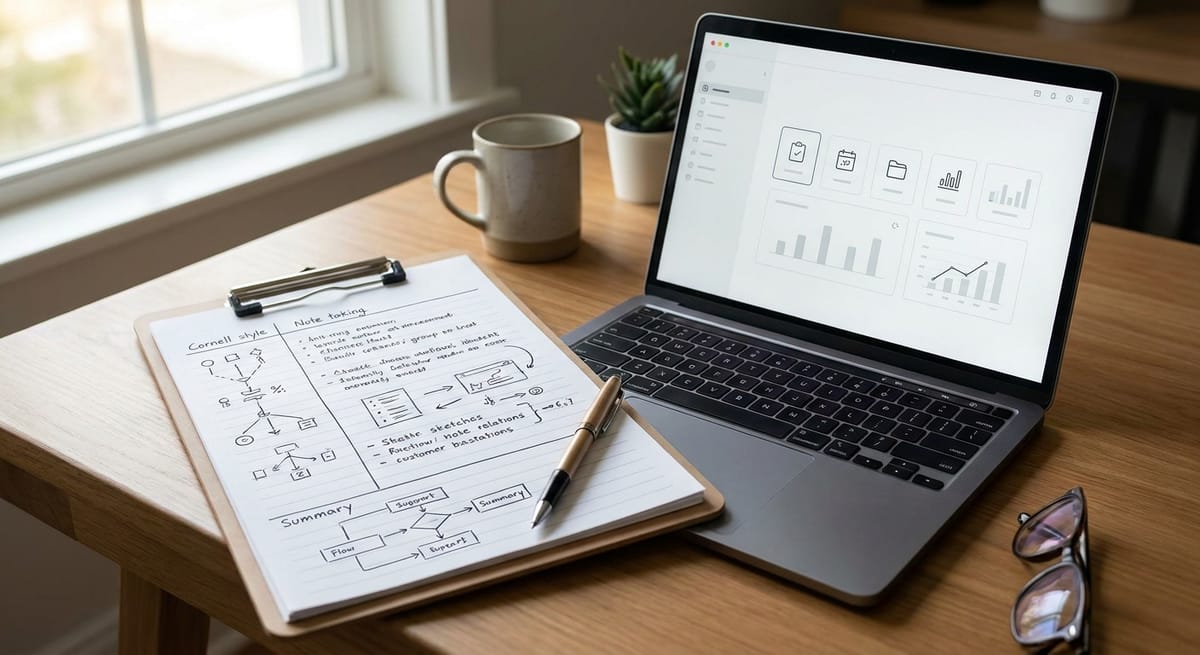 Better notes are built for recall, not for looking complete.
Why most note-taking quietly fails
Most notes fail because they capture words instead of meaning — you become a stenographer, not a thinker. The act of transcribing verbatim keeps your attention on catching up rather than on understanding, and understanding is the only thing that lasts.
Psychologists Pam Mueller and Daniel Oppenheimer named this trap in their 2014 study The Pen Is Mightier Than the Keyboard. Students who typed took more notes and scored worse on conceptual questions than students who wrote by hand. Why? The typists could keep up, so they transcribed. The writers couldn’t, so they were forced to summarise — to decide what mattered.
That forced selection is the whole game. When you can’t record everything, your brain has to process the material to compress it, and processing is what encodes memory. The everyday struggle here has a clinical cousin: passive re-reading, which feels like studying but produces what researchers call the fluency illusion — mistaking familiarity with a page for actual knowledge.
The mechanism: what a note is actually for
A note has two jobs, and confusing them is why note-taking so often disappoints. Job one is encoding — building the memory in the moment. Job two is retrieval — giving your future self a cue to rebuild that memory later.
Here’s the reframe that dissolves a lot of self-blame. The purpose of a note is not the note. The purpose is the change it produces in the brain of the person writing it. A beautiful page you never think about again has done almost nothing; a messy scrawl that made you wrestle with an idea has done a great deal.
Two well-supported principles drive this:
- The generation effect: you remember information you produce yourself far better than information you simply read. Rephrasing a definition in your own words beats copying it, every time.
- Desirable difficulties: Robert Bjork’s research shows that a bit of struggle during learning — effortful, slightly slower — produces stronger, more durable memory than smooth, easy input.
So the counterintuitive truth is this: notes that feel a little harder to make are usually the ones worth having. Comfort during learning is often the enemy of remembering.
What is the best method for taking better notes?
The best method is any structured system that forces summarising and builds in questions for later recall — the Cornell method and the Feynman technique both do this well. There’s no single winner; there’s a match between method and material.
Here’s how the most useful systems compare on what actually matters — not aesthetics, but how much each one forces your brain to work.
| Method | Best for | Forces summarising? | Builds in recall? |
|---|---|---|---|
| Cornell | Lectures, structured reading | Yes — cue column | Yes — questions + summary |
| Feynman | Deep concepts you must explain | Strongly | Yes — teach-it-back |
| Mind mapping | Connected, visual topics | Moderate | Weak unless reviewed |
| Outline | Hierarchical, logical material | Moderate | Weak |
| Verbatim transcript | Almost nothing | No | No |
The Cornell method, briefly
Divide the page: a wide right column for notes, a narrow left column for cues, a strip at the bottom for a summary. Take notes on the right during input. Afterwards, write questions in the cue column and a two-line summary at the foot. The structure itself schedules the review.
The Feynman technique
Explain the idea, on paper, as if teaching a curious twelve-year-old. Where your explanation stalls or turns to jargon, you’ve found the hole in your understanding. Go back, fill it, simplify again. It’s uncomfortable — which is exactly why it works.
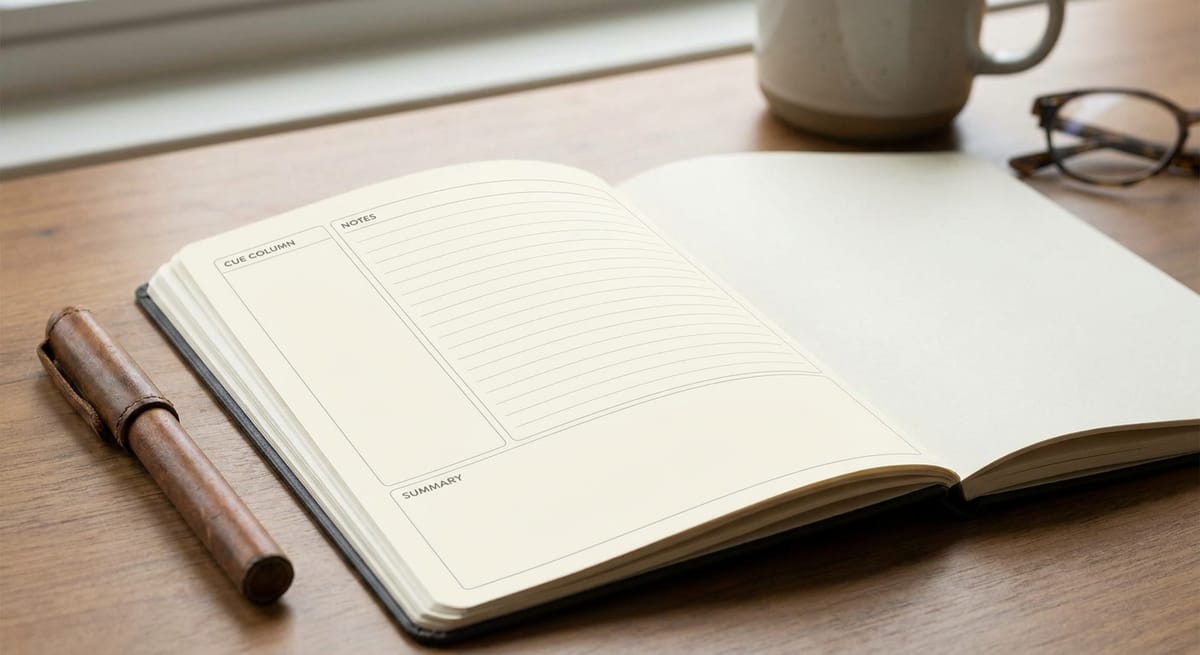 The Cornell layout builds retrieval questions into the page itself.
Should you take notes by hand or on a laptop?
Handwriting tends to win for conceptual learning because it’s slower and forces summarising; typing wins for volume, search and reorganisation. The right answer depends on whether you’re capturing raw material or building understanding.
The Mueller–Oppenheimer finding above favours the pen — but it’s not the paper that helps, it’s the constraint. A slow input channel forces selection. If you type, you can recreate that constraint deliberately: don’t transcribe, paraphrase; cap yourself to a few bullet points per idea.
A practical split many people find works:
- By hand for lectures, dense books, and anything you need to understand deeply.
- Digital for reference material, meeting minutes, and notes you’ll search, link, or restructure later.
- Hybrid — handwrite to think, then type a distilled version. That second pass is itself a spaced review.
Whatever you choose, treat it like any behaviour you want to stick: make the friction low. Keeping your notebook or app one tap away is a small application of reduce friction habits — the environment does the remembering so willpower doesn’t have to.
How do you make notes you’ll actually remember?
You remember notes by reviewing them through active recall at spaced intervals — testing yourself from the cues rather than re-reading the answers. The note is the seed; the review is where the memory actually grows.
This is the step almost everyone skips, and it’s the one that matters most. Hermann Ebbinghaus mapped the forgetting curve in the 1880s: without review, memory decays sharply within days. Each act of successful retrieval flattens that curve and buys you more time before the next fade.
A simple, evidence-based review loop:
- Same day: spend five minutes turning your notes into questions (the Cornell cue column does this automatically).
- Cover and recall: hide the notes, answer the questions from memory, then check. The effort of retrieval is the point — not the tidiness of the answer.
- Space it: revisit after a day, then a few days, then a week. Widen the gaps as recall gets easier.
- Connect it: link each new idea to something you already know. Elaboration builds more retrieval routes.
To make the review actually happen, anchor it to something you already do — read your cues while the kettle boils, or after your morning coffee. That’s habit stacking doing the heavy lifting: a reliable existing cue triggers the new behaviour, so it doesn’t depend on remembering to remember.
Common note-taking mistakes to stop making
The biggest mistakes all share one root: mistaking activity for learning. Neat pages, colour-coding and highlighting can all feel productive while doing almost nothing for memory.
- Highlighting everything. Passive marking creates fluency without recall. If most of the page is yellow, none of it is prioritised.
- Transcribing verbatim. If you’re keeping up perfectly, you’ve stopped thinking. Slow down and compress.
- Never reviewing. Notes without review are a diary of things you once briefly knew.
- Perfectionism. Rewriting notes to make them pretty feels like study but is mostly copying. Spend that effort on recall instead.
- One system for everything. Match the method to the material — Feynman for concepts, outline for structure.
Notice how each fix trades comfort for a little productive difficulty. That’s the through-line. If a study habit feels effortless, be suspicious of it.
Key takeaways
- A note’s real purpose is the change it makes in your memory, not the artefact on the page.
- Forced summarising — writing in your own words — beats verbatim capture because of the generation effect.
- Handwriting helps mainly because it’s slow enough to force selection; you can replicate that constraint when typing.
- Cornell and Feynman work because they bake questions and re-explanation into the process.
- Review is non-negotiable: active recall at spaced intervals is what defeats the forgetting curve.
- Anchor your review to an existing habit so it happens without relying on willpower.
Frequently asked questions
How do I learn to take better notes if I’ve always struggled?
Start by changing one thing: stop transcribing and force yourself to paraphrase. Pick a single method — Cornell is the gentlest — and add a five-minute same-day review where you turn notes into questions and answer them from memory. That retrieval step is where most of the benefit lives, and it compounds within a fortnight.
Is it better to take notes by hand or type them?
Handwriting generally helps understanding because its slowness forces you to summarise, as Mueller and Oppenheimer showed in 2014. Typing suits high-volume, searchable, or reorganisable material. If you type, deliberately paraphrase and limit yourself to a few bullets per idea to recreate the useful constraint of writing by hand.
What is the Cornell note-taking method?
Cornell splits each page into three zones: a main notes column, a narrow cue column for questions, and a summary strip at the bottom. You take notes during input, then afterwards write recall questions and a short summary. The layout builds active review into the process, which is why it consistently outperforms plain linear notes.
How often should I review my notes?
Follow spaced repetition: review the same day, then after roughly one day, three days, and a week, widening the gaps as recall gets easier. Each successful retrieval flattens Ebbinghaus’s forgetting curve. Consistency beats intensity — short, frequent, effortful reviews outperform a single long cram session before you need the material.
Why don’t I remember anything from my notes?
Almost always because you’re re-reading instead of retrieving. Passive review creates the fluency illusion — the page feels familiar, so you assume you know it. Cover your notes and try to reconstruct them from cues. The struggle to recall is uncomfortable, but that effortful retrieval is precisely what turns notes into durable memory.
If this clicked, the same mechanism-first thinking runs through everything on the site — start with our Habits hub to build the review routine that makes better notes stick, or visit Start Here for the foundations. Real change isn’t magic; it’s mechanism — and now you’ve got this one.