Spaced Repetition: The Proven Way to Remember Anything
Spaced repetition is a learning method that schedules your reviews at widening intervals — right at the edge of forgetting — so each recall drives the memory deeper. It's the closest thing we have to a lawful way of remembering, and it has almost nothing to do with talent.
TL;DR
- Spaced repetition schedules reviews just as you’re about to forget, forcing your brain to rebuild the memory and making it stronger each time.
- It works because of the forgetting curve and the testing effect — retrieval, not rereading, is what wires knowledge in.
- Tools like Anki automate the timing; the habit only sticks when you make the daily review small and frictionless.
What’s in this guide
- What is spaced repetition?
- Why does spaced repetition work?
- The forgetting curve, explained
- How do you actually use spaced repetition?
- Best spaced repetition tools compared
- Common mistakes that quietly kill your results
- Key takeaways
- Frequently asked questions
Spaced repetition is a learning method that schedules your reviews at widening intervals — right at the edge of forgetting — so each recall drives the memory deeper. It’s the closest thing we have to a lawful way of remembering, and it has almost nothing to do with talent.
Picture the night before an exam. It’s late, the coffee’s gone cold, and you’re reading the same paragraph for the fourth time, hoping repetition alone will glue it in. It won’t. By the weekend most of it will be gone, and you’ll blame your memory rather than the method.
Here’s the reframe that dissolves the self-blame: forgetting isn’t a flaw in you. It’s a feature of the system. Spaced repetition doesn’t fight that feature — it exploits it. Real change isn’t magic, it’s mechanism, and once you understand the mechanism, the tools stop sounding like platitudes.
 Reviews stretch further apart as each memory strengthens — the core of spaced repetition.
What is spaced repetition?
Spaced repetition is the practice of reviewing information at increasing intervals — a day, then three days, then a week, then a fortnight — instead of cramming it all at once. Each successful recall pushes the next review further out.
Contrast it with massed practice, the technical name for cramming. Massed practice feels productive because the material stays fluent while it’s in front of you. That fluency is a trap. Fluency in the moment is a terrible predictor of what you’ll remember next week.
The everyday version of this struggle has a clinical cousin: the illusion of knowing. You recognise a fact and mistake recognition for retrieval. Spaced repetition breaks that illusion by making you produce the answer from a blank page, then timing the next test to arrive just before you’d lose it.
Why does spaced repetition work?
It works because effortful retrieval is what consolidates memory, and spacing forces effortful retrieval. When recall is slightly hard, your brain reconstructs the memory and strengthens the pathway — a phenomenon researchers call desirable difficulty.
Two mechanisms are doing the heavy lifting here.
The testing effect
Psychologists Henry Roediger and Jeffrey Karpicke showed in a widely cited 2006 study that students who tested themselves on material remembered far more a week later than those who simply reread it — even though rereading felt easier. The act of retrieving is the act of learning, not just a check on it.
The spacing effect
When the gaps between reviews widen, each recall happens against a fading memory. That’s not a bug. Recalling something that’s begun to fade builds a more durable trace than recalling something still fresh. A 2019 review in npj Science of Learning summarised decades of evidence that distributed practice reliably outperforms massed practice across ages and subjects.
Notice the pattern shared with real behaviour change: the difficulty isn’t the enemy. If it’s too easy, nothing consolidates. This is the same logic behind Yerkes Dodson law — performance and learning peak at moderate, not minimal, arousal.
The forgetting curve, explained
The forgetting curve describes how memory for new information drops sharply within hours and days unless it’s reinforced. Spaced repetition times each review to land at that drop-off, resetting the curve to a shallower slope.
Hermann Ebbinghaus, testing himself on nonsense syllables in the 1880s, first mapped this decay. His finding still holds: without review, you lose the majority of new material within a day or two. But each properly timed review flattens the curve — the memory decays more slowly the next time.
Think of it as sanding a groove. The first pass barely marks the wood. Each subsequent pass, timed well, deepens the same groove until it holds without effort.
 Each timed review flattens the forgetting curve — memory decays more slowly with every pass.
How do you actually use spaced repetition?
To use spaced repetition, turn what you want to remember into question-and-answer prompts, then review each one at expanding intervals, deferring cards you get right and repeating cards you get wrong. Software handles the timing for you.
Here’s a practical starting sequence:
- Write atomic prompts. One fact per card. “What year did Ebbinghaus publish his memory research?” beats a paragraph you have to recite.
- Test, don’t reread. Cover the answer, retrieve it, then check. The struggle is the point.
- Grade honestly. If you hesitated, mark it hard. Fooling the algorithm only fools yourself.
- Let the intervals stretch. Easy cards drift to weeks and months; hard cards come back tomorrow.
- Review daily, briefly. Ten focused minutes beats a two-hour weekend binge.
The hardest part isn’t the method — it’s showing up. This is a behaviour-change problem, not a memory problem, so treat it like one. Attach your review to something you already do with habit stacking: cards with your morning coffee, every day, same cup. And keep the barrier low, because willpower fails exactly when you’re tired. Reducing friction beats resolving to try harder.
Best spaced repetition tools compared
The right tool is the one you’ll open daily. Most run a variant of the same spacing algorithm; they differ in cost, polish and how much control they hand you.
| Tool | Best for | Algorithm | Cost |
|---|---|---|---|
| Anki (desktop/Android) | Serious, long-term learners | SM-2 / FSRS | Free (iOS app ~R450) |
| Quizlet | Quick, casual study sets | Proprietary | Free / paid tier |
| RemNote | Notes plus review in one place | SM-2 based | Free / paid tier |
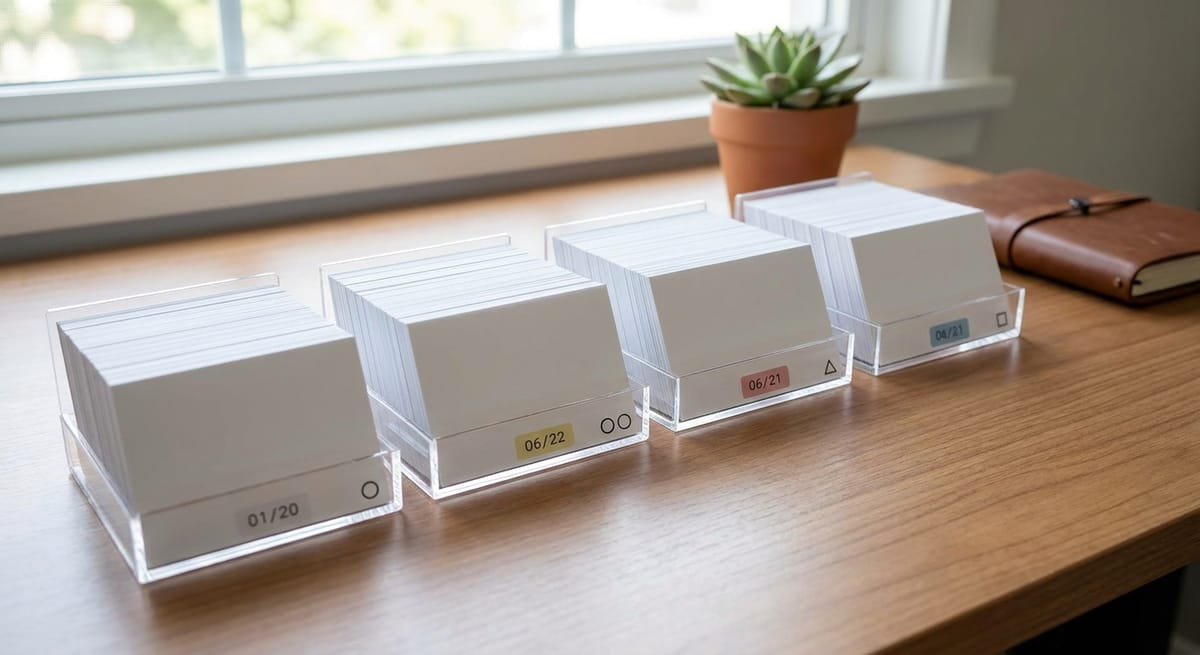
| Paper Leitner box | No screens, tactile learners | Manual boxes | Near-zero |
If you want the honest answer: Anki is the workhorse. It’s plain, sometimes ugly, and endlessly configurable. The paper Leitner system — physical cards moved through boxes as you get them right — proves you don’t need software at all. The algorithm matters less than the discipline.
Common mistakes that quietly kill your results
Most failures with spaced repetition aren’t about the schedule — they’re about the cards and the habit around them. Get those two right and the method almost runs itself.
- Cards that are too big. A prompt asking for five facts trains none of them. Break it up.
- Passive recognition. Multiple-choice feels easier and teaches less. Force free recall.
- Skipping days, then bingeing. A backlog of 400 cards is a wall you’ll avoid. Small and daily wins.
- Memorising without understanding. Spacing cements what you’ve grasped; it can’t manufacture comprehension you never had.
- Grading dishonestly. Marking a shaky recall as “easy” tells the algorithm to leave you exposed.
There’s a mindset dimension here too. If you frame every forgotten card as evidence you’re “bad at this,” you’ll quit. That’s a fixed reading of a normal process. The shift towards a growth-oriented view — forgetting as data, not verdict — is what keeps people in the game long enough to see the returns.
Key takeaways
- Spaced repetition schedules reviews at widening intervals, timed to the edge of forgetting.
- It works through the testing effect and the spacing effect — retrieval under mild difficulty is what consolidates memory.
- The forgetting curve is a feature to exploit, not a flaw to fight; each timed review flattens it.
- Write small, atomic, free-recall prompts and grade yourself honestly.
- Anki and the paper Leitner box both work — daily consistency beats any algorithm.
- Treat review as a habit: stack it, keep it short, and reframe forgetting as feedback.
Frequently asked questions
Does spaced repetition actually work for adults?
Yes. Spaced repetition works across ages and subjects because it exploits how memory consolidates, not youthful biology. Decades of research on the spacing and testing effects show distributed, self-tested review reliably outperforms cramming for children and adults alike. The main variable in adults isn’t capacity — it’s consistency, so build the daily review into an existing routine.
How many cards should I review each day?
Start with 10 to 20 new cards a day and let reviews accumulate naturally. Most people can sustain 100 to 200 total reviews in 15 to 20 minutes once the deck matures. If you’re dreading the session, you’ve added new cards too fast — pause new material and let the backlog clear before scaling up.
What’s the difference between spaced repetition and cramming?
Cramming (massed practice) packs review into one session; spaced repetition distributes it across widening intervals. Cramming feels fluent but fades within days. Spacing feels harder in the moment because you’re recalling fading material, and that very difficulty produces durable, long-term retention. For anything you need next month rather than tomorrow, spacing wins decisively.
Can I use spaced repetition without any software?
Absolutely. The Leitner system uses physical flashcards moved through numbered boxes: get a card right and it advances to a box reviewed less often; get it wrong and it returns to box one. It’s tactile, screen-free and captures the core mechanism perfectly. Software just automates the timing and scales more gracefully to thousands of cards.
Why do I still forget cards I’ve reviewed many times?
Persistent forgetting usually signals a card problem, not a memory failure. The prompt may be ambiguous, too large, or lack understanding beneath it. Rewrite it into something specific and atomic, add a memorable cue or example, and consider whether you actually grasp the concept. A well-designed card that keeps failing is rare; a vague one that does is common.
Ready to turn this into a habit that lasts? See how to make any new routine effortless in our guide to reducing friction in habits, or begin at Start Here to build your self-development on mechanism, not motivation.